
3.1 Introduction
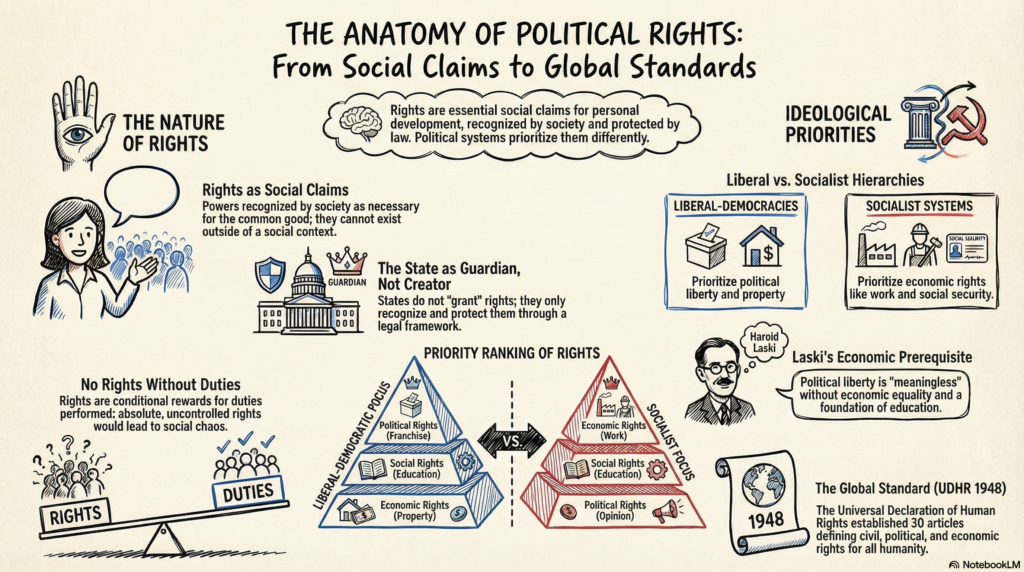
Rights are social claims that help individuals attain their best selves and develop their personalities. A democratic government can best serve the people by maintaining a system of rights. States never give rights, they only recognise them; governments never grant rights, they only protect them. Rights emanate from society and from peculiar social conditions — they are always social. They belong to individuals, exist for individuals, and are exercised by them for the full development of their personalities.
3.2 Rights: Meaning and Nature
The relationship between individuals and the state is a central question of political theory.
- Idealists (e.g., Plato): the state alone can give justice; the individual’s duty is to serve the state to the best of his/her abilities.
- Liberals (e.g., John Locke): the state as a means exists for an end — the individual; individual rights are sacrosanct and inviolable.
The concept of individual rights as guarantees against state absolutism, originating in society, emerged in 15th–16th century Europe.
3.2.1 Rights, Claims and Powers
- Claims ≠ Rights: a claim not recognised is an empty claim; a claim not enforced is a powerless claim. Claims become rights only when recognised by society and maintained and enforced by the state.
- Rights are social claims — not merely claims, but claims social in nature. Rights presuppose the existence of society; there are no rights outside society.
- Talking about natural rights in the state of nature (as social contract theorists did) is a misnomer — rights are social because they exist in society, are granted by society, and are granted to members of society.
- Rights are given as rewards in response to duties the individual has performed towards society. Rights are never anti-social — there are no anti-social rights.
- The state (distinct from society) maintains the framework of rights — provides them to all and protects individuals’ rights against encroachments by executive authorities, other individuals, or groups.
Rights vs. Powers:
- Power = physical force; a natural endowment to satisfy needs. Mere force cannot establish a system of rights.
- As individuals we have powers; as social beings (members of society) we have rights.
- Rights are recognised powers — powers recognised as socially necessary for the individual.
- Hobhouse: “Rights are what we may expect from others and others from us, and all genuine rights are conditions of social welfare… conditioned by, correlative to, his social responsibilities.”
3.2.2 Meaning of Rights
Rights are social claims necessary for the development of human personality — not entitlements or privileges.
| Rights | Privileges |
| Claims on others (and others’ claims on us) | Entitlements granted to some, denied to others |
| Universal — assured to all | Possessed by few |
| Given without discrimination | Given to selected few |
| Obtained as a matter of right | Obtained as a matter of patronage |
| Feature of democratic societies | Feature of undemocratic systems |
Key definitions:
- Jefferson: men are endowed by their creator with certain inalienable rights — indicates the naturalness of rights but offers no precise definition.
- Holland: rights are “one man’s capacity of influencing the act of others, not by his own strength but by the strength of the society” — describes rights as social claims but misses other aspects.
- Wilde: “A right is a reasonable claim to freedom in the exercise of certain activities” — gives casual treatment to the social claim aspect.
- Bosanquet: “A right is a claim recognized by society and enforced by the state.”
- Laski: “Rights are those conditions of social life without which no man can seek, in general, to be himself at his best.”
Bosanquet and Laski include the positions of society, state, and personality but both ignore the important aspect of duty as a part of rights.
A working definition of rights must include:
- The social claim aspect — rights originate in society; no rights prior to, above, or against society.
- The development of personality aspect — rights belong to the individual and promote personality; includes the right to oppose government if its action is contrary to individual development.
- The state’s role — the state does not grant rights, it only maintains them. “A state is known by the rights it maintains” (Laski).
- Rights are socially sanctioned claims preceded by duties. Duties are prior to rights — this makes rights limited, not absolute. There are no absolute rights — absolute rights are a contradiction in terms.
Raphael rightly asserts that the distinction between rights as ‘liberties’ and rights as ‘claims’ has become an important matter for social and political theory.
3.2.3 Nature of Rights
Key features of the nature of rights:
- Rights are social claims — recognised as such by society; without recognition they are empty claims.
- Rights are social — they emanate from society at any given point of time; they never existed before the emergence of society; they cannot be exercised against the common good.
- Rights create conditions necessary for the development of human personality — these conditions are created and provided by the state, which is the protector, not the originator, of rights. If the state fails to maintain these conditions, it forfeits its claim to the allegiance of individuals.
- Rights are dynamic — their contents depend on the customs and ethos of society at a particular time and place; as society changes, so do the contents of rights. No universally applicable, permanent list of rights can ever be formulated.
- Rights are responses/rewards — given after duties have been performed towards society. It is after “owing” that we “own.”
- Rights are not absolute — absolute, uncontrolled rights would lead to anarchy and chaos.
3.3 Theories of Rights
The development of rights followed a historical progression: civil rights (contractualists) → rights from tradition (historicists) → rights from law (jurists) → political rights (democrats) → social rights (sociologists/pluralists) → socio-economic rights (socialists/Marxists) → human rights (United Nations).
3.3.1 Theory of Natural Rights
Advocates: Thomas Hobbes (Leviathan, 1651), John Locke (Two Treatises on Government, 1690), J.J. Rousseau (The Social Contract, 1762).
These contractualists held that men possessed natural rights in the state of nature as essential properties of their humanity. Rights are therefore declared inalienable, imprescriptible, and indefeasible.
Criticisms:
- Rights cannot exist before the emergence of society — the notion of pre-society rights is a contradiction in terms. What existed in the state of nature were mere physical energies, not rights.
- Rights presuppose an authority to protect them; no such authority existed in the state of nature.
- Making rights natural renders them absolute, beyond social control.
- Bentham: the doctrine of natural rights is “a rhetorical nonsense upon stilts.”
- Laski: rejects natural rights entirely; rights based on the false assumption that we can have rights and duties independently of society.
- Burke: we cannot enjoy the rights of civil and uncivil state simultaneously; the more perfect natural rights are in the abstract, the more difficult it is to recognise them in practice.
Laski’s nuanced position: Rights are natural not in the sense that a permanent catalogue can be compiled, but “natural in the sense that under the limitations of a civilised life, facts demand their recognition.”
3.3.2 Theory of Legal Rights
Advocates: Bentham, Hegel, Austin.
Rights are granted by the state — a claim which the force of the state grants to the people. Key features:
- The state is the source of rights — rights are neither prior nor anterior to the state.
- The state lays down a legal framework that guarantees and enforces rights.
- When the content of law changes, the substance of rights changes.
Criticism: The state defends and protects rights; it does not create them. Accepting the state as creator of rights implies the state can also take them away — making the state absolute and leaving individuals with only those rights the state chooses to grant.
3.3.3 The Historical Theory of Rights
Also called the prescriptive theory. Advocates: Edmund Burke (18th century), later adopted by sociologists.
Rights grow from traditions and customs. Burke argued that people have a right over anything they exercise or enjoy uninterruptedly over a long passage of time — every right is based on the force of long observance. As traditions and customs stabilise through constant usage, they become rights.
Importance: Condemns both the legal theory and the theory of natural rights by asserting historical continuity.
Criticism: Not all customs result in rights — the Sati system and infanticide are customs but do not constitute rights. Not all rights have their origins in customs — the right to social security, for example, is unrelated to any custom.
3.3.4 The Social Welfare Theory of Rights
Advocates: Bentham (18th century), Roscoe Pound, Chafee (modern).
Rights are conditions of social welfare — the state should recognise only such rights as help promote social welfare. Claims not in conformity with general welfare do not become rights.
Criticism: “Social welfare” is too vague a term to be precise. The Benthamite formula — “greatest good of the greatest number” — means different things to different people. If the state decides what constitutes “social welfare,” the theory collapses into the legal theory of rights. Wilde: if rights are created by social expediency, “the individual is without an appeal and helplessly dependent upon its arbitrary will.”
3.3.5 The Marxist Theory of Rights
Rights are understood in terms of the economic system at a particular period of history. A particular socio-economic formation produces a particular system of rights.
- The state is an instrument of the economically dominant class — its laws are class laws.
- Feudal state: protects rights/privileges favouring the feudal system.
- Capitalist state: protects rights favouring the capitalist system. The class that controls the economic structure also controls political power, using it to promote its own interests.
- Socialist state: through proletarian laws, protects and promotes the rights of the working class. Being classless, the socialist state protects the rights of all people.
- Order of rights in socialism: economic rights (work, social security) first → social rights (education) → political rights (franchise).
Criticism: Marxism suffers from deterministic ideology — the economic factor alone does not provide the basis of society; non-economic forces also shape the superstructure. However, its emphasis on a non-exploitative socialist system is its characteristic strength.
3.4 Framework of Rights
Rights are essential conditions of human personality. Different state systems recognise different rights — liberal-democratic societies prioritise political rights; socialist societies prioritise economic rights. Rights incorporated in a constitution are called fundamental rights.
3.4.1 Rights of the People
Right to life — the most basic right; without it all other rights are meaningless. The state guarantees protection of life against any injury; even suicide is considered a crime.
Right to equality — equality before law, equal protection of law, prohibition of all discrimination (social, economic, political). Protective discrimination (as in the Constitution of India) is an integral part of this right.
Right to freedom — freedom of speech, press, assembly, association, movement, residence, and adopting a vocation; exercised within reasonable restrictions (as in India’s Constitution).
Right to freedom of religion, conscience, and faith — religion is a matter of personal faith; does not curtail secularism because religion and public life are not allowed to intermix.
Right to education — essential for the development of personality; illiteracy is a social curse; the state must promote education.
Economic rights — right to work, right to social security, rest and leisure; right to property (right to possess and inherit — important in liberal democracies).
Political rights — franchise, contesting elections, holding public office, forming political parties; these rights make individuals full-fledged citizens.
Fundamental Rights in the Constitution of India: right to equality, right to freedom, right against exploitation, right to freedom of religion, cultural and educational rights, and right to constitutional remedies. The last is especially important as it ensures guarantees for all other rights.
Liberal-democratic vs. Socialist priority of rights:
| Liberal-Democratic | Socialist |
| Political rights → Social rights → Economic rights | Economic rights → Social rights → Political rights |
| Right to freedom > Right to equality | Right to work precedes right to education |
| Right to property > Right to work | Right to education precedes right to independent opinion |
3.4.2 Laski’s Theory of Rights
Harold Laski (1893–1950) — theoretician of the English Labour Party; expounded his theory in A Grammar of Politics (first published 1925, revised frequently).
Laski’s views on rights:
- Rights are social conditions given to individuals as members of society.
- They help promote individual personality — “those social conditions without which no man can seek to be his best self.”
- They are social — never against social welfare; did not exist before the emergence of society.
- The state only recognises and protects rights; it does not grant them.
- Rights are never absolute.
- Rights are dynamic — their contents change according to place, time, and conditions.
- Rights go along with duties; duties are prior to rights.
Laski’s order of rights (most to least urgent):
- Right to work
- Right to adequate wages
- Right to reasonable hours of labour
- Right to education
- Right to choose one’s governors
- Other rights
Laski’s argument: Without economic rights first, an individual cannot enjoy political rights. “Political liberty is meaningless without economic equality; where there are great inequalities, the relationship between men is that of the master and the slave.” Education (social right) equips individuals to exercise all other rights properly.
3.4.3 Theory of Human Rights
S. Ramphal: human rights were not born of men but were born with them — not so much a result of UN efforts as emanations from basic human dignity.
Human rights are those rights inherent to our nature without which we cannot live as human beings. They enable us to use and develop our faculties, talents, and intelligence; they assert the inherent dignity and worth of each human being.
Human rights in the UN Charter: the Preamble affirms faith in fundamental human rights, dignity, worth of the human person, and equal rights of men, women, and nations. Articles 13, 55, 62, 68, and 76 reference promotion of universal respect for human rights.
Universal Declaration of Human Rights (UDHR): drafted by the Commission on Human Rights (under the UN Economic and Social Council), under the chairmanship of Roosevelt, over approximately two and a half years. Approved by the UN General Assembly on 10 December 1948 — now celebrated as Human Rights Day. Contains 30 articles.
Structure of the UDHR:
| Articles | Category | Key Rights |
| 3–15 | Traditional/Civil rights | Right to life, liberty, security; freedom from arbitrary arrest; fair trial; equal protection of law; freedom of movement; right to nationality; right to seek asylum |
| 16–21 | Civil and Political rights | Equal rights of men and women; right to marry and form a family; right to property; freedom of thought and expression; peaceful assembly and association; share in government of one’s country |
| 22–27 | Economic, Social and Cultural rights | Right to work; protection against unemployment; just remuneration; right to form trade unions; rest and leisure; adequate standard of living; education; participation in cultural life |
| 28–30 | Social/international order | Social and international order for realisation of rights; duties towards community; guarantees of rights |
International Bill of Human Rights — UDHR is its first segment, followed by:
- International Covenant on Economic, Cultural and Social Rights
- International Covenant on Civil and Political Rights
- Optional Protocol
All three were adopted in 1966.
3.5 Summary (Key Takeaways)
- Rights are social claims necessary for the development of human personality — given by society, secured by the state; even the state cannot take them away.
- Rights reflect a particular stage of social development — dynamic, not absolute.
- No theory of rights offers a complete account: natural rights theory correctly stresses their social-claim character; legal theory correctly makes the state their guarantor.
- Rights range from civil and political to economic, social, and cultural.
- Liberal democracies prioritise personal and political rights; socialist societies reverse this order.
- Laski (liberal leaning left) prioritises economic rights, followed by social and political rights.
- The UN Declaration of Human Rights (1948) provides the foundational global list of rights belonging to human beings as human beings.
