
2.1 Introduction: The Origins of the Democratic Ideal
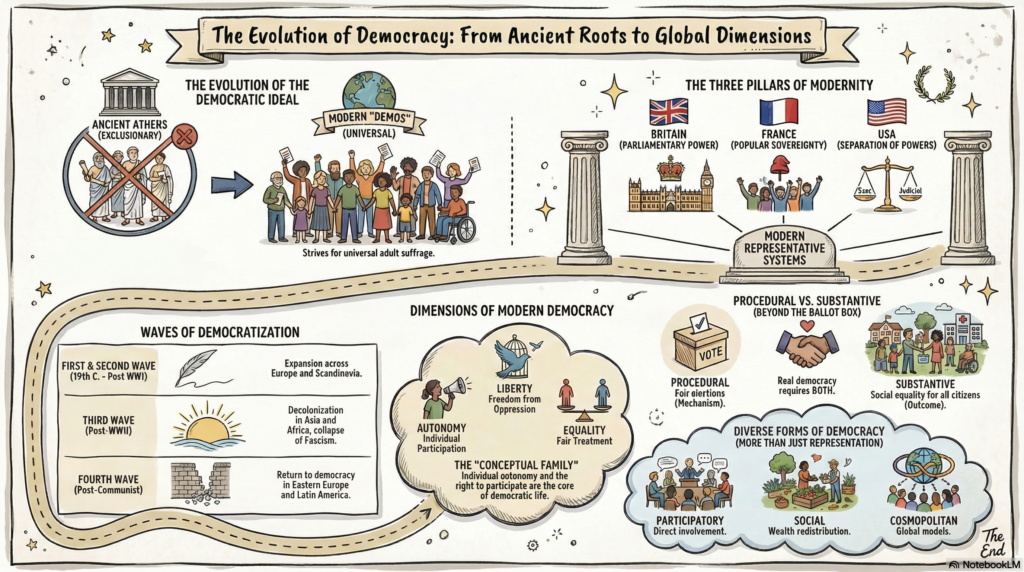
- 1992 marked 2500 years of democracy — no other political ideal has been celebrated in this way.
- Ancient Athens is widely considered the most stable, enduring, and model form of democracy in ancient Greece.
Etymology: Greek demokratia = demos (people) + kratos (rule) → government in which the people rule, either directly (through personal participation) or indirectly (through elected representatives).
Ancient vs. Modern democracy: The key difference lies in how “the people” were defined. In the ancient Greek polity, demos was restrictively defined — it excluded three categories: slaves, women, and metics (foreigners living and working in the city-state). Barely a quarter of the total population were members of the citizen body.
- Despite this, direct participation by a 40,000-strong citizen body was a significant achievement.
- The assembly deliberated and took decisions on all policy matters, meeting on as many as 300 days in the year.
- Citizens were also chosen by lot to serve in official administrative and judicial positions.
- Athenian democracy was troubled in practice — aristocrats, generals, and demagogues made periodic attempts to control power; the poor were contemptuously described as “the mob” or “the rabble.”
- The struggle for democracy throughout history has simultaneously been a struggle against political inequality based on inequalities of birth and wealth.
2.2 Historical Background
Democracy is described as one of the “characteristic institutions of modernity” — the result of complex, intertwined processes of ideological, social, and economic change.
- Britain: Change signalled by the Industrial Revolution (mid-18th century).
- France & America: Change launched by political revolutions in the last quarter of the 18th century.
Britain
- Regarded as the first modern democracy: after the Civil War (17th century), royal absolutism was ended and powers transferred from the Crown to the two Houses of Parliament — one of which, the House of Commons, was an elected chamber.
- Franchise was highly restricted (based on property ownership); political conflict was peacefully conducted between competing elites (aristocracy and bourgeoisie).
- Reform Act of 1832: enfranchised the upper middle classes — beginning of suffrage expansion.
- Franchise gradually extended to the working classes, partly in response to movements like Chartism.
- By the last quarter of the 19th century (three Reform Acts later): about two-thirds of the male population enfranchised.
- 1929: Women secured the right to vote.
- 1948: Universal adult suffrage fully achieved when plural voting was abolished in favour of one-person one-vote.
France
- More radical democratic tradition inaugurated by the Revolution of 1789 — Liberty, Equality, Fraternity — with emphasis on popular sovereignty.
- Declaration of the Rights of Man and Citizen: proclaimed rights of personal liberty, freedom of thought and religion, security of property, and political equality as natural and imprescriptible entitlements not just of French citizens but of “mankind” at large.
- Revolutionary constitution of 1791: established near-universal male suffrage; 4 million male citizens won the right to vote.
- 1795: More restrictive property requirements reduced voters to just 100,000 prosperous taxpayers.
- Universal male suffrage reintroduced after the Revolution of 1848.
- 1946: Universal adult franchise — women won the right to vote.
United States of America
- After the Civil War, advance of democracy was restricted to white men.
- Enfranchisement of women, indigenous people, and Black people was not achieved until the 20th century.
- Declaration of Independence (1776): simultaneously effected the legal creation of the USA and that of democracy in that country.
- Though slavery continued until the mid-19th century, the American Revolution gave the modern world its first democratic government and society — hereditary power of monarchy and aristocracy was overthrown.
- Important institutional mechanism: separation of powers between the executive, legislature, and judiciary — preventing any one branch from exercising arbitrary or untrammelled power.
Key Ideas and Documents Underpinning Modern Democracy
- Political ideas of the Levellers, John Locke, and Tom Paine.
- French Declaration of the Rights of Man (1789) and American Declaration of Independence (1776).
- These are also seen as charters of liberalism — hence the early emphasis in democratic theory on liberty rather than equality.
The Levellers (17th century England): advanced a radical conception of popular sovereignty and civil liberties; advocated near-universal male suffrage (excluding servants, criminals, and women); interrogated property ownership as the basis for political rights.
John Locke, Second Treatise on Government (1681):
- State of nature governed by a Law of Nature: no individual ought to harm another in life, health, liberty, or possessions.
- Natural equality of men (as equal creatures of God) gives them equal right to freedom.
- No agency exists in the state of nature to enforce the law → endless possibilities for conflict → transcended through a social contract.
- Social contract founded in consent of every individual = basis of legitimate government.
- Civil law must conform to natural law; purpose of government = preservation of life, liberty, and property.
- If government fails in this purpose, the people have the right to resist and replace it.
- This articulates the core principles of classical liberalism: individualism, popular sovereignty, and limited government — the foundation of liberal democracy.
American Declaration of Independence (1776): followed Locke in describing as natural and inalienable the rights to life, liberty, and the pursuit of happiness (the last widely interpreted as an euphemism for property). The continued exclusion of slaves and women illustrates the contradiction between the universalism of liberal principles and the selectivity of liberal practices.
Liberal democracy is a historically specific form of democracy based on a culturally specific theory of individuation — it combines liberalism as a theory of the state with democracy as a form of government. The connection between liberalism and democracy is historical, not necessary. Societies that attach greater significance to the community than the individual may adopt democratic procedures (free elections, freedom of speech) without the liberal component — making it possible to speak of “different ways of being democratic” or being “differently democratic.”
Waves of Democratisation (20th Century)
The 20th century saw an unparalleled extension of democracy in terms of both inclusiveness and spatial expansion — described as “waves of democratisation”:
| Wave | Period | Characteristics |
| First | 19th century | Democratisation of many countries in Europe |
| Second | Post-World War I | Many European countries, including Scandinavia, became democratic |
| Third | Post-World War II | New democracies in Germany and Italy after collapse of Nazism/Fascism; decolonisation in 1950s–60s — democracy adopted by new nations of Asia and Africa |
| Fourth | Post-Communist era | Return to democracy in Eastern Europe; many Latin American countries that had turned their backs on democracy |
2.3 The Conceptual Family of Democracy: Autonomy, Rights, Liberty, and Equality
Democracy belongs to a conceptual cluster in which rights, freedom, and equality are most central. Underpinning these is the principle of individualism and individual autonomy, developed especially in the writings of Thomas Hobbes and John Locke.
- Autonomy: the value attached to possessing control over one’s own person, decisions, and life-choices. Individuals are autonomous beings capable of rational thought and of determining what is good for them.
- Since individuals are also members of collectives, they assert the right to participate in collective decision-making — this is an act of self-determination.
In classical liberal political theory:
- Government must guarantee the rights and personal liberty of the individual — protecting life, liberty, and property from other individuals and the state alike.
- All individuals equally possess these rights by virtue of being human beings.
Equality in political decision-making — two types:
- Prospective equality: everyone starts off with an equal chance of determining a decision, free from disabilities that prevent them from doing so.
- Retrospective equality: in a decision already taken, everyone equally determined that decision.
Since unanimous decisions are rare, decision by majority is the only procedure that satisfies the test of democracy — it fulfils prospective equality and is the best in terms of retrospective equality.
Freedom vs. Equality as starting points:
- Freedom-centred view: greatest importance to individual rights and personal freedoms; state should play a limited, minimal role; it is illegitimate for the state to tax wealthy citizens to provide subsidised services for poorer citizens.
- Equality-centred view: formal political equality is of little use unless individuals possess the real capacities to determine their life-plans; social and economic inequalities of caste or class must first be removed.
2.4 Justifications for Democracy: Intrinsic and Instrumental
Intrinsic value: democracy is valuable for its own sake — it is the fairest way of giving expression to equality among citizens.
Instrumental value: democracy is good as a means to other ends:
- Fosters competition among political leaders → better choice of leadership.
- Makes everyone feel part of the decision-making process.
- Minimises the abuse of political power by distributing it equally.
- Encourages people to take responsibility for their political lives → human development.
The moral superiority of democracy lies in the fact that no other procedure for arriving at decisions binding on all takes everybody’s interests equally into account. This implies people are the best judges of their own interests and that equal citizenship rights are necessary to protect those interests.
Even when individuals agree on general purposes, they disagree on how to achieve them → democracy represents a fair moral compromise among people who live within the same state but do not share a single conception of the good life.
Since unanimity is impossible, majority rule is the most practicable procedure. This is why Winston Churchill described democracy as “the worst form of government except for all the rest.” However, the moral value of democracy lies not in majority rule itself but in the principle of equality that underpins it.
2.5 Democracy: Procedural and Substantive
Modern democracy works through representative institutions because direct democracy is not possible in large, complex societies. People elect representatives to a legislature; ultimate sovereignty remains with the people, who hold representatives accountable through elections.
Procedural democracy: views democracy merely as a set of institutions — free and fair elections, legislative assemblies, constitutional governments. Its limitation is that it fails to account for the fact that formal political equality may coexist with real inequality — poorer, less educated, and socially disadvantaged citizens are often unable to fully exercise their democratic rights.
Substantive democracy: a society of truly equal citizens who are politically engaged, tolerant of different opinions and ways of life, and have an equal voice in choosing and holding accountable their rulers. The outcomes of the democratic process would then reflect the interests of all, not just a few powerful groups. Democracy becomes the organising principle of all collective life in society, not just of government.
Background conditions for equality must be met — social inequality makes formal political equality relatively meaningless. Free exercise of the franchise may require freedom from caste superiors, dominant landlords, or (for women) the male head of household. People also need independent decision-making power and adequate access to relevant information.
In societies with religious, linguistic, or ethnic minorities, the majority principle tends to disadvantage minorities — they may be systematically outvoted and never have a real opportunity to influence outcomes.
2.6 Types of Democracy
Representative Democracy and its Critics
The mechanism through which people participate indirectly in government is by electing representatives to carry out their will.
- Hobbes and Locke: representative government is a form of government authorised by the people to act on its behalf.
- Rousseau: sovereign power should rest in the hands of the citizenry and its “general will” — representatives’ opinions and interests can never be identical to those of the electorate.
Representative democracy has two types of critics:
- Those who consider it unrealistic — Schumpeter and elite theorists.
- Those who consider it inadequate — participatory democrats.
Schumpeter’s “realist” theory of democracy: The classical 18th-century theory mistakenly assumes that sovereignty lies with the people who elect individuals to an assembly to carry out their will. In reality, democracy is not about popular sovereignty — its main purpose is to elect leaders from among competing candidates. Leadership is the driving force; the people merely endorse one or another leader.
Participatory Democracy
Found in the writings of Rousseau and John Stuart Mill.
- Rousseau: requires participation of every individual citizen in political decision-making. Citizens are interdependent — each equally dependent on all others collectively as sovereign. Participation protects private interests and ensures good government.
- Mill: participation has an educative function. Popular democratic government is his ideal polity — participatory institutions foster active citizenship and a public-spirited character. Democratic institutions, especially local ones, are “a school of political capacity.”
Contemporary advocates — Carole Pateman and Benjamin Barber — argue for participatory or “strong” democracy in which ordinary citizens are more fully involved in decision-making than is possible within representative democracy. This could involve strengthening local democracy, community affairs, and social movements. Political participation is central to the good life and helps restrain abuse of power by public officials.
Deliberative Democracy
Values open and public deliberation on issues of common concern. Views individuals as autonomous persons whose social relationships are not ones of conflict or interest, but of reasoned argument and persuasion.
- Persuasion is the best basis for political power — it respects individual autonomy and capacity for self-government.
- Unlike participatory democracy, it allows for a political division of labour between citizens and professional politicians — citizens deliberate on public issues but need not be constantly engaged in decision-making.
- Promotes greater and continuous accountability of political power.
Social Democracy
Based on a strong commitment to equality. Social democrats support:
- The welfare state based on redistribution.
- Liberal institutions of representative democracy combined with the ideal of social justice.
Social democracy is more egalitarian than liberalism (which often takes the form of right-wing libertarianism) but less radical than Marxian socialism — it stands at the intersection of these two ideologies. Famously described as “more than democracy and less than socialism.”
Social democrats argue that all individuals should get an equitable share of society’s resources to realise their own life-plans. If poverty, disability, or minority status are obstacles, the state has a duty to remove such obstacles. Particularly concerned with the well-being of workers, women, the disabled, the elderly, and members of cultural minorities. Sees democracy as both a form of government and a principle that should inform all collective life in society.
Cosmopolitan Democracy
Advanced in the context of globalisation — with the rise of supranational organisations (e.g., the European Union) and economic and cultural globalisation, democracy must respond to challenges beyond the borders of the nation-state.
- Points to a global civil society created by “globalisation from below.”
- New solidarities forged across national borders give rise to cosmopolitan citizenship — the environmental movement and the women’s movement are notable examples.
- Key unresolved questions: Do communications and internet revolutions make governments more or less accountable? Is citizen participation in global institutions genuinely possible?
- Example problem: the majority of WTO members are developing countries representing a majority of the world’s citizens, yet the WTO remains responsive to more prosperous nations. How can institutions of global governance be democratised?
2.7 Summary (Key Takeaways)
- Democracy evolved from ancient Athens (direct, restrictive) to modern representative democracy (inclusive, universal suffrage).
- Its conceptual family includes autonomy, rights, liberty, and equality.
- Justifications are intrinsic (morally fair in itself) and instrumental (produces better outcomes).
- Procedural democracy emphasises institutions; substantive democracy emphasises real equality of participation and outcomes.
- Types: representative, participatory, deliberative, social, and cosmopolitan democracy — each responding to different limitations of the previous form.
